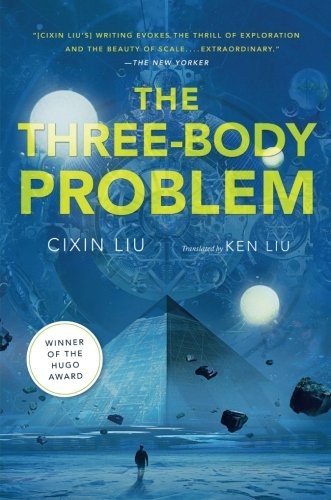
This is essentially a four hundred page setup for a trilogy, and I mean that almost as a compliment, because the setup is the part that grabbed me hardest and I’m not sure the back half of the book, once things start actually happening, ever quite tops it.
It opens during China’s Cultural Revolution, and that section alone would work as its own short, devastating piece of historical fiction before the science fiction elements even arrive. Ye Wenjie’s arc, from what she witnesses as a young woman to the choice she makes decades later at a remote research installation, is the emotional core the rest of the book keeps returning to, and Ken Liu’s translation preserves something in the rhythm of it that reads distinctly non-western in a way I found refreshing rather than difficult.
The Three Body videogame sections in the present-day timeline are the part I’ve seen readers split hardest on. Some find it drags, all that in-game physics and civilization-building before it pays off. I was fully engaged, because once you realize what the game is actually simulating, the true nature of Trisolaris and its three suns, it recontextualizes everything, and the “aha” is worth the patience it demands getting there.
Characters are the acknowledged weak point, even among people who love this book, more vehicles for the ideas than people you attach to emotionally, which lines up with a pattern I keep noticing in the hardest of hard SF. The science, meanwhile, especially once you hit the true physics of the three-body orbital problem itself, is genuinely compelling rather than decorative, a rare case where I wanted the textbook tangents to keep going.
Four stars, docked slightly for pacing in the middle third, but I picked up the sequel almost immediately after finishing, which tells you where I actually landed on it.