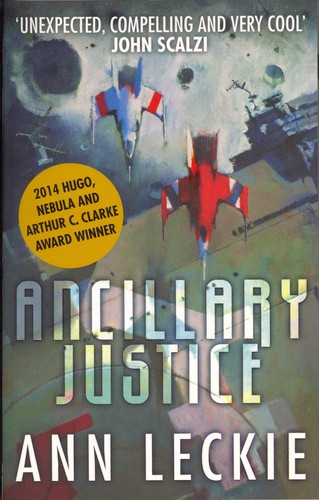
Breq used to be Justice of Toren, an AI running an entire troop ship and a few thousand ancillary bodies, all one distributed consciousness experiencing everything at once. Now she’s a single body on a mission of vengeance, and the whole book is quietly, insistently about what’s lost when a mind that vast gets pruned down to one perspective.
The gender thing gets talked about more than anything else with this book, and for good reason, the Radch civilization Breq comes from doesn’t distinguish gender at all, so the narration defaults every person to “she” regardless. I’ll admit I expected that to read as a gimmick and it doesn’t, it actually reshapes how you picture every character, and there’s a genuinely funny recurring bit where Breq visibly struggles to guess correctly in languages that do require gendered pronouns, getting it wrong in ways that read as completely reasonable from someone who’s never had to track that distinction.
Structurally it runs two timelines, present-day vengeance plot and flashback to the ship’s last mission and what went wrong, and I know some readers bounce off the uneven pacing between them. I didn’t. The flashback sections are where the multiplicity of consciousness actually gets shown instead of explained, Breq-as-ship experiencing a dozen bodies’ worth of simultaneous sensory input, and that’s the best writing in the book.
One character shows up who is, unambiguously, everybody’s favorite for a reason I won’t spoil, and the emotional current running under the space opera plot caught me off guard given how cool and procedural the prose can be on a sentence level. It’s not showy writing. It’s controlled in a way that makes the moments it does let loose land harder.
Five stars, and I’ve reread it since, which for me is the real tell. Second time through, once you already know what you’re looking at, some of the flashback structure lands even better.