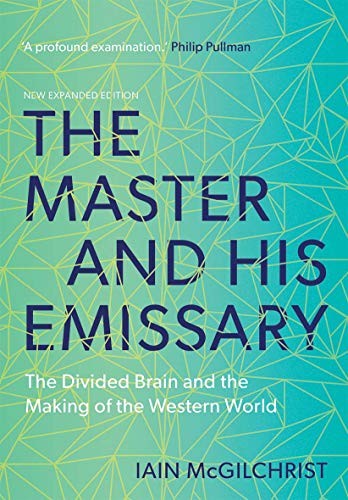
I went in assuming this was going to be another round of the pop-psychology left-brain-right-brain thing, the kind of framework that gets trotted out to explain why you’re “more creative” or “more logical” and then falls apart the second you look closely. It is not that. McGilchrist is a psychiatrist who’s also done neurological research and taught English literature, and that combination shows up on nearly every page.
His actual claim is narrower and stranger than the popular version: it’s not that one hemisphere does logic and the other does feelings, it’s that the two hemispheres attend to the world in fundamentally different ways, one holds the broad, contextual, living picture (the Master), the other narrows in, grasps, categorizes, and manipulates (the Emissary, meant to serve the Master but increasingly running the show on its own). The back half of the book applies that to the sweep of Western intellectual history, and that’s where it gets genuinely ambitious, maybe too ambitious for some readers.
It’s a long, slow read, no way around that. I put it down for stretches and came back to it, which is normal for a book like this, not a knock against it exactly. The density of research citations backing every claim is reassuring if you want rigor, but it does mean this isn’t something you breeze through on a commute.
The detail that stuck with me most, oddly, wasn’t from the neuroscience chapters but a small aside about language evolving alongside the ability to manipulate objects with the right hand specifically, this quiet reminder that abstract cognition and physical dexterity aren’t as separate as we like to think. That kind of connection is what the whole book is built on, threading a needle between hard science and something closer to philosophy.
Four stars. It asks a lot of you and doesn’t fully stick every landing in the historical survey, but it changed how I notice my own attention shifting between the wide view and the narrow grasp, and that’s not nothing.