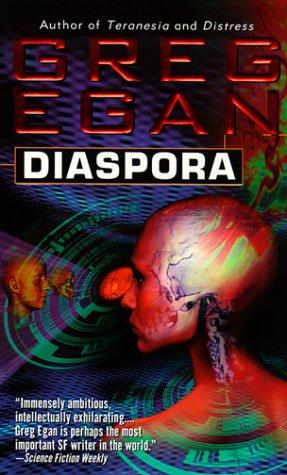
So it’s the thirtieth century and humanity has split three ways: fleshers still living in bodies on Earth, robotic Gleisners wandering around in the physical world with digital minds, and citizens of the polises, digital consciousnesses running inside vast underground computers who basically never touch a body again. I want to give this book five stars and I also want to give it one star, and somehow both of those feelings are accurate at the same time.
Egan lays down ideas the way other writers lay down scenery, casually, constantly, like it costs him nothing. Multiple instances of the same person running simultaneously, what happens to identity when there’s no single “you” anymore, orphanogenesis (new minds designed from scratch rather than born), it just keeps coming and none of it feels padded out for the sake of a page count.
The opening chapter is the one people either love or bounce off immediately, an entire birth-of-a-digital-mind sequence explained partly through actual math, fiber bundles and Euler-adjacent concepts rendered as narrative. I’m not going to pretend I followed every equation-adjacent passage. I didn’t. But the clarity of the prose around the density is what saved it for me, Egan writes clean sentences even when the content inside them is genuinely difficult.
Where it costs you: character. These are not people you fall in love with the way you might in a more traditional novel, they’re vehicles for the ideas, and if you need emotional throughlines to carry you, the middle stretch involving the macroscopic quest to reach other diaspora communities and investigate a cosmic threat can feel colder than it should. I found myself completely fine with that trade. Not everyone will be.
Five stars because I haven’t read anything else this committed to taking transhumanist ideas to their actual logical extreme instead of using them as set dressing. This is the book other hard SF gets compared against in my head now.