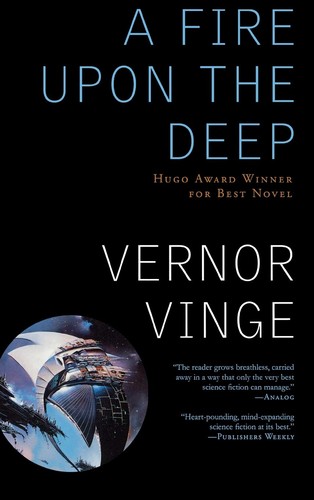
Okay so the elevator pitch nobody gives you upfront: one of the main characters is a pack of 3 to 8 dogs sharing a single mind, and they have to stay within a certain distance of each other or the personality starts to come apart. I’ve read a lot of science fiction and that concept alone put this in a different category for me before anything else happened.
The Zones of Thought are the actual engine of the book, the idea that physics and the speed of possible thought change depending on where you are in the galaxy. Earth sits in the Slow Zone, where faster-than-light travel is impossible, and things get weirder and more powerful the further out you go, until you hit the Transcend, where beings basically become gods. It’s a big swing of an idea and Vinge commits to it completely instead of hand-waving it as flavor text.
I’ve seen the plot summarized as “two people walking across a room from different sides, for 600 pages,” which is funny and also kind of accurate, because the character work is thin compared to the conceptual scaffolding around it. That’s the tradeoff here. You’re not reading this for people you’ll think about for years, you’re reading it because the worldbuilding is doing something almost nobody else attempts at this scale, an entire galaxy’s ecology of intelligence, and it holds together.
The blight, the big threat driving the plot, could have used more page time honestly, it functions more as an inciting incident than a fully realized villain by the end. And the alien Tine society gets a disproportionate amount of focus relative to how much weight it’s carrying. Neither of those complaints stopped me from finishing it in about four sittings.
Five stars, not because it’s flawless, but because I haven’t stopped thinking about the zones of thought since I read it, and that kind of idea sticking with you is rarer than a clean plot.